

Applications & Databasesbetav1.0.0
AUXTA
Real-time decisioning for gaming infrastructure — vector-oriented, self-hosted, sub-millisecond.
About
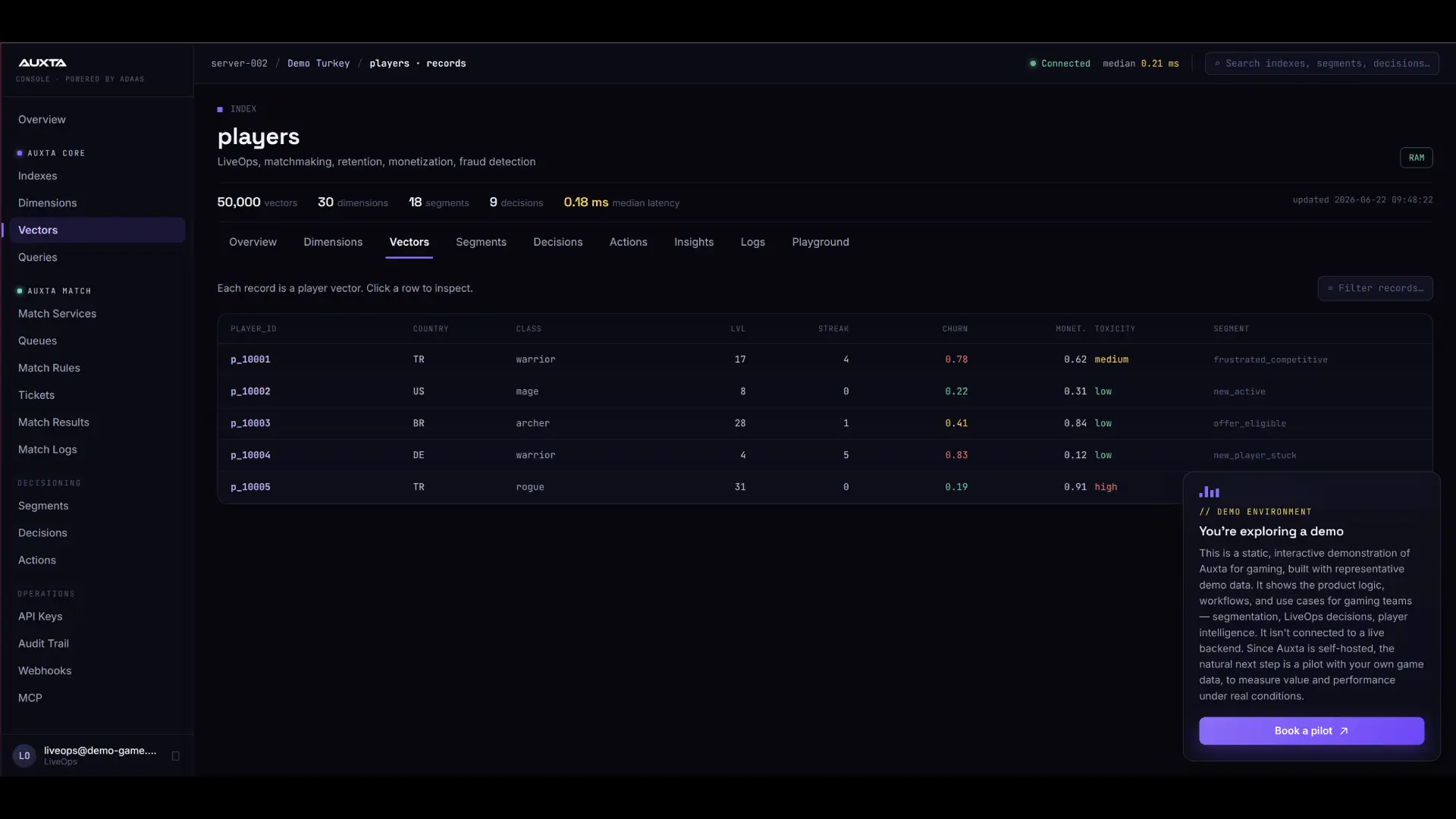
AUXTA is a vector-oriented, self-hosted decisioning database built for gaming infrastructure. Create indexes and add dimensions without reindexing, build live segments, attach decisions, trigger actions, and inspect every execution in sub-millisecond detail. Gaming-native and powered by ADAAS, it runs LiveOps, matchmaking, retention, and fraud on a single real-time source of truth.
What makes AUXTA worth your time.
- Vector-oriented indexes — add dimensions without reindexing.
- Live segments with attached decisions and triggered actions.
- Sub-millisecond execution (< 0.2 ms) with full per-execution inspection.
- Self-hosted, gaming-native infrastructure powered by ADAAS.
- Purpose-built for LiveOps, matchmaking, retention, and fraud.
Bring up a single-node AUXTA instance and open the console.
- Pull the image
docker pull ghcr.io/auxta/auxta:latest - Run a node
docker run -p 7070:7070 ghcr.io/auxta/auxta:latestExposes the console and decisioning API on port 7070.
- Open the console
open http://localhost:7070Sign in with the demo credentials to explore.
What’s new in recent releases.
- v1.0.02026-07-02
- General availability — self-hosted, gaming-native release.
- Sub-millisecond decisioning with full per-execution inspection.
- Live segments with attached decisions and triggered actions.
- v0.9.02026-05-20
- Add dimensions to indexes without reindexing.
- Fraud and retention starter segments.
Get AUXTA on your platform.
System requirements- Deployment
- Self-hosted — Docker or bare metal
- Architecture
- Microservices — several service types that scale horizontally with the workload
- Minimum
- t3.small per node (2 vCPU / 2 GB) — current dev environment
- CPU
- AVX2-capable x86-64 (vector engine)
- Memory
- 16 GB RAM per node recommended for live indexes
- Storage
- NVMe SSD recommended for live indexes
- Orchestration
- Kubernetes 1.27+ or Docker Compose