
A-OS
An operating environment for AI-developed applications — where the application, not the agent, is the primitive, and every app's capabilities compose through one unified, AI-native experience.
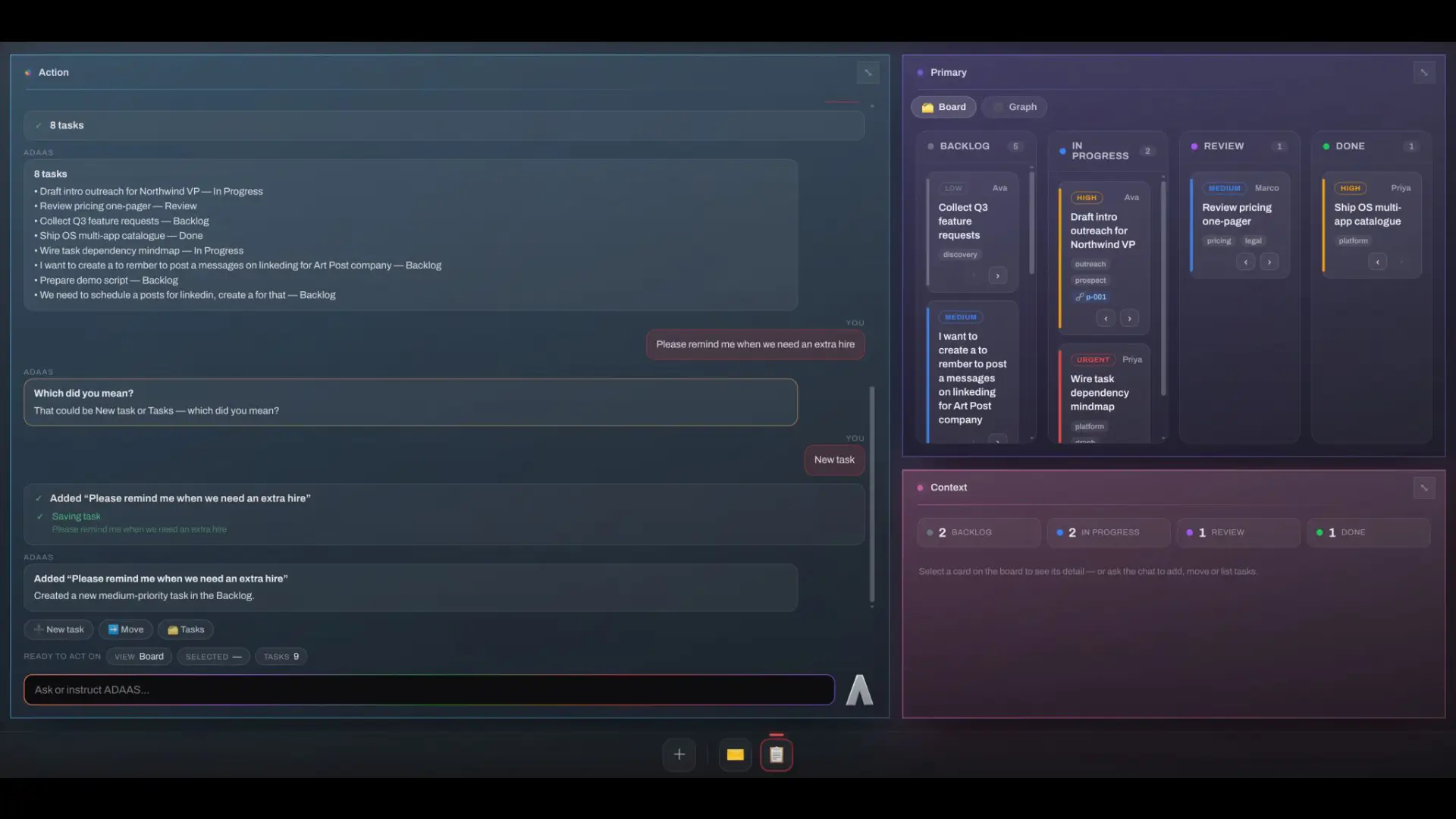
A-OS is a web-based operating environment for AI-developed applications. Most AI software today is agent-centric: a single general agent sits at the center and everything else — tools, connectors, documents, memory — is something the agent reaches for, while the context that guides the work lives invisibly inside a conversation. A-OS organizes many of the same AI capabilities around a different architectural primitive: the application rather than the agent. The application supplies the interface, the domain context, the workflows, the permissions and the surface where humans and AI meet — and AI operates inside that structure. Every application runs in a consistent three-display window: an Action display where the user directs the AI and the AI performs actions, a Primary display that is the application's real working surface, and a Meta display that keeps the knowledge, entities, state and capabilities the AI is using visible on screen. Applications declare their capabilities to the environment, so both people and AI agents can discover what is available in the current context and compose capabilities across application boundaries. A-OS does not compete with the Model Context Protocol or Skills — it incorporates them as mechanisms by which an application publishes what it can do, then adds the interface, context and composition around them.
What makes A-OS worth your time.
- Application-centric model — the application is the primitive that provides interface, domain context, workflows and permissions; AI operates inside its structure instead of being one more tool an agent picks up.
- Three-display architecture — every app runs in a consistent AI-native window: Action (direct the AI), Primary (the real work surface) and Meta (the live context panel), always on screen together.
- Visible context — the Meta display shows the customer, account, portfolio, policy and task the AI is working inside, so context is inspectable and governed rather than buried in a chat transcript.
- Capability discoverability — each application declares its capabilities to the environment, so humans and AI agents discover what is available and permitted in the current context instead of guessing.
- Capability composition — capabilities from different applications become skills that participate in shared workflows that cross application boundaries, experienced by the user as one flow.
- Humans and AI agents together — a person can invoke a capability directly and an AI agent can chain the same capabilities as part of a larger task, in one shared environment.
- Incorporates MCP and Skills — uses the Model Context Protocol and Skills as one of the ways an application exposes tools and capabilities, then adds interface, context and governance around them.
- A unified shell — application discovery, navigation, interaction, skills, plugins, AI-driven workflows and contextual actions, balancing application independence with a unified user experience.
A-OS is delivered and licensed directly — here is how bringing applications into the environment works.
- Request access
Contact us to scope the A-OS environment and the applications you want to unify.
- Bring in applications
Add AI-developed applications — each declares its capabilities to the environment via MCP, Skills and A-OS capabilities.
- Work in one environment
People and AI agents discover and compose capabilities across apps through the Action, Primary and Meta displays, with context always visible.
A-OS is an enterprise operating environment for AI-developed applications, offered as a managed or self-hosted deployment under a commercial arrangement. Request access and we’ll scope the environment, the applications you want to bring in, and the rollout for your organization. The canonical product overview lives at adaas.ai/a-os.
System requirements- Deployment
- Web-based — managed by ADAAS or self-hosted in your environment
- Model
- Application-centric — applications are the primitive, AI operates inside their structure
- Applications
- AI-developed apps, ideally created and evolved with AIS Studio
- Capabilities
- Exposed via MCP, Skills and application-declared capabilities
- Governance
- Context-level permissions and visible, inspectable AI context